- Analytics
- Trading News
- xAI Leeching off SpaceX
xAI Leeching off SpaceX
SpaceX reported its Q3 results on October 20, and the numbers were strong. Revenue was $14.58 billion, up 161% from a year earlier.
SpaceX made $2.8 billion from running its businesses in the quarter, after a loss of $273 million a year earlier. About $2.4 billion of that came from Starlink. The AI segment added $431 million, and the launch business lost $7 million. The stock rose about 8% the next day and closed at $159.31.
By Friday, October 30, it had fallen to $134.72, below its June IPO price.
The question is why a company that beat expectations lost so much value within days.
The results did not change. The supply of shares did.
The first drop came on October 22, two days after the Q3 results. That day up to 1.31 billion shares became eligible for sale by early investors and employees. Under the rules insiders could not sell their shares for a set period after the IPO., well that set period expired on October 22nd and stock fell 9%, to $144.75.
More shares are coming - 800 million more will become eligible on December 8, and Elon Musk’s roughly 6.4 billion shares stay locked until about June 2027. Insiders who bought at low prices have good reasons to sell shares.
Why SpaceX fall continued
On October 30 shares dropped 6.37%, and it came during sell-off driven by worries that AI spending will not earn enough.
SpaceX spent $19.6 billion on equipment and buildings in the quarter, and $16.4 billion of that went to the Super Intelligence segment.
Over nine months it produced $13.1 billion of cash from operations and spent $48.1 billion on equipment.
SpaceX said it expects to spend $35 billion to $40 billion on equipment and buildings in the last three months of the year. It had already spent $48.1 billion in the first nine months, so the total for 2026 would be about $83 billion to $88 billion. SpaceX held about $89.9 billion in cash and securities on September 30, so it can pay for this, but a large part of that cash will be used.
Super Intelligence produced $7.56 billion of revenue, 52% of the total, up from $813 million a year earlier.
Super Intelligence had $7.56 billion of revenue in the quarter, up from $813 million a year earlier. SpaceX says the revenue came from three sources:
- customers paying to use its computing capacity,
- subscriptions and business use of its Grok chatbot,
- and sales of the Cursor coding tool. Cursor’s sales are included only because SpaceX bought the company in August, so they were not in last year’s figure. SpaceX has not said how much revenue each source brought in.
The Super Intelligence segment made an operating profit of $431 million. That is after a $1.2 billion charge for stock given to Cursor when SpaceX bought the company.
The company’s $4.4 billion net income is larger than its $2.8 billion operating profit. SpaceX reported about $1.0 billion of other income, also recorded a $390 million tax benefit, meaning it owed less tax than it had set aside.
Over the first nine months, SpaceX still lost $413 million, that means the first six months lost about $4.8 billion, and this quarter’s profit recovered most of it.
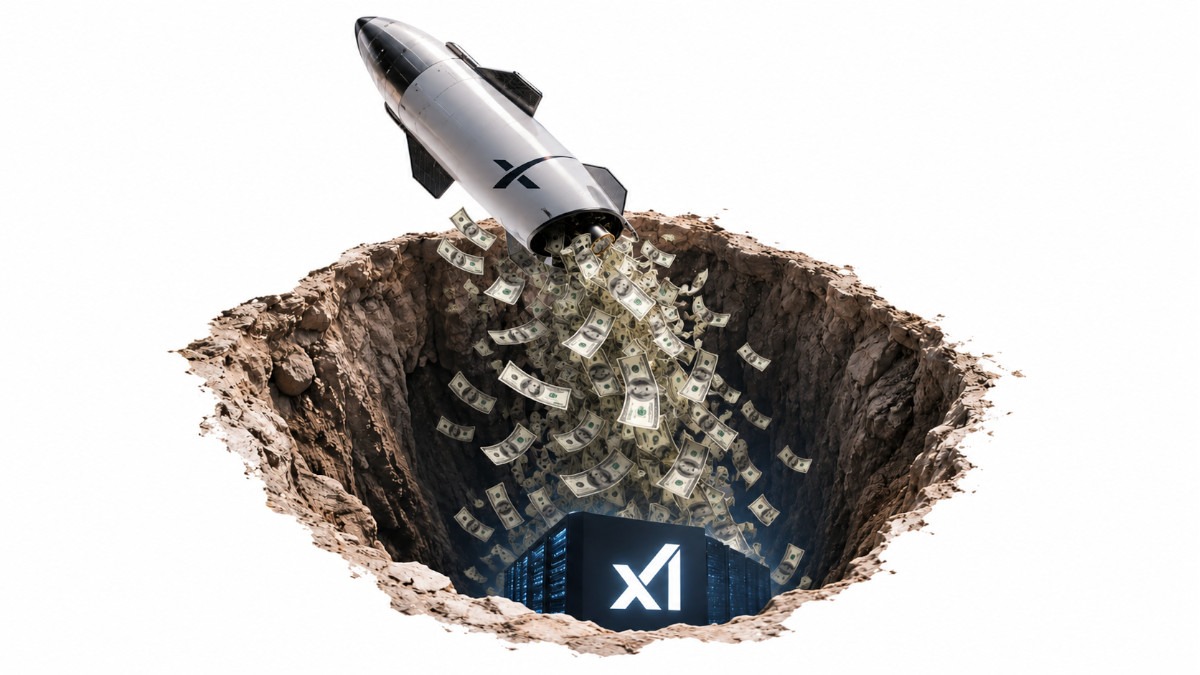
xAI leeches off SpaceX
Before Musk’s purchase, xAI was losing more money than it earned - in 2025 company lost $6.4 billion from operations on $3.2 billion of revenue, and it spent $12.7 billion on equipment. In the first three months of 2026 it lost another $2.5 billion and spent $7.7 billion on equipment.
SpaceX could afford that, and xAI alone could not. Starlink’s Connectivity segment earned $4.4 billion of operating profit in 2025 and $2.37 billion in the third quarter of 2026 alone. In its IPO filing, SpaceX said it expected a long period of heavy investment before the AI segment would make sustained profits.
On the October earnings call, the finance chief said the spending would be paid for from cash the business produces, from borrowing, and from partners.
SO
Investors may be selling because Musk merged xAI, his money-losing AI company, into SpaceX in February, four months before the IPO. Since the merger, Starlink’s profits and the money from the IPO have helped pay for AI equipment, and xAI’s results are reported together with Cursor and the computing-rental contracts, so outsiders cannot see how xAI itself is doing.
An investor who sees that SpaceX is a profitable business carrying a very costly one has a reason to sell.
New powerful tool, SpaceX Technicals
New powerful tool, SpaceX Technicals
Live Technical Analysis with instant forecast using most popular indicators and oscillators.
Try Now

If you don’t find a way to make money while you sleep, you will work until you die.- Warren Buffett